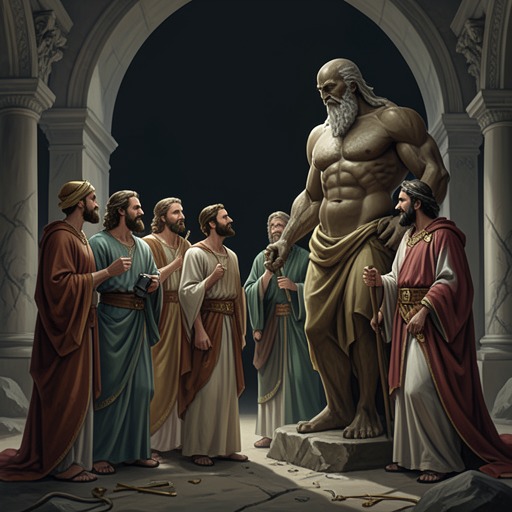
Independent Deity Status
Systema Delenda EstIndependent Deity Status names the condition of gods who possess worlds and divine authority without belonging to the Nine Great Clans. In the late crisis of the System, that status becomes more than an administrative distinction: it is a test of whether sovereignty can exist outside the institutions that claim to preserve order. Independent gods are treated simultaneously as autonomous rulers, possible allies of Cato, and ungoverned dangers whose worlds may be seized or destroyed in the name of collective security.
Definition and Political Position
Independent deities occupy a deliberately unstable place within the System’s hierarchy. They are powerful enough to govern worlds and resist ordinary pressure, yet they lack the protection and institutional standing enjoyed by members of the Great Clans. Mii-Es describes them as a scattered set of independent polities in the Inner Worlds and nearby frontier, comprising a few dozen gods who refused to submit to clan management. Their refusal has allowed them to obstruct the expansion and political maneuvering of the Great Clans, making independence a material obstacle rather than a merely symbolic preference.
The status also carries a distinctive relationship to territory. An independent god’s world is not simply a personal estate; it is the foundation of a political community whose survival depends on retaining control of its resources and defenses. That makes the proposed incorporation into a clan deceptive. Ikel tells Urshal that the Eln Clan merely wishes to merge him into its ranks, but the actual plan is to move compliant independent gods to minor locations where they can no longer cause trouble, while perhaps allowing a few to retain worlds judged insignificant. The offer therefore preserves the language of membership while stripping away the substance of sovereignty.
Pressure from the Core
The conflict surrounding Independent Deity Status intensifies after Cato’s war gives the Nine Great Clans a pretext for consolidation. Mii-Es reports that the Elns have used the conflict to demonstrate both that Cato is a threat and that they are willing to burn their own planets when necessary. The independent gods consequently come under heavy pressure, even when they have not openly acted against the Core. Misse’s policy is that worlds outside the Great Clans cannot be trusted to behave as the Core considers necessary, so even apparently inactive independents are to be brought into line in stages, preventing them from forming a unified response.
The policy is backed by exceptional powers. Misse authorizes Muar, acting as a Crusader, to distribute divine gifts that allow Azoth-rank and higher agents to fight Cato’s forces. She also identifies independent worlds as likely targets for the harshest approach. The stated emergency turns ordinary political integration into a security operation, and condemnation becomes a tool of governance: worlds may be declared compromised, cleared of their populations or assets, and removed from the political map rather than negotiated with as equals.
The danger is not theoretical. Marus and Initik suspend traffic to and from Sydea, using their authority as World Deities to gray out both portals leading to Urivan. The action demonstrates how divine office can convert territorial control into isolation at a stroke. Independent status offers no guarantee against this kind of blockade; a god may remain nominally sovereign while access, movement, and communication are controlled by higher authorities or by emergency powers claimed in the System’s name.
Resistance and Counter-Organization
Cato recognizes that the Core’s campaign will not be defeated by confronting every independent god in a single battle. Mii-Es urges him to reach threatened gods first and help them sever their worlds from the System before the Core can burn them out or take everything they have built. Her proposal is defensive as well as strategic: rescue the communities attached to independent sovereignty rather than allowing their worlds to become examples of submission.
The resulting plan is to assemble a dispersed cabal of sympathetic deities. Mii-Es proposes beginning with gods who are most amenable to Cato’s offer, distributing contacts widely enough that the removal of some members will not destroy the network. Those deities could persuade other independents to leave the System. Cato considers staging his movements so that the Core believes his forces are being driven away from certain frontier pockets, thereby preserving time and making the consolidation more difficult. Initik already knows that Cato has been working with someone because Mii-Es’s contingency plans bear the recognizable character of Cato’s methods, turning the independent coalition into a concealed political front rather than a simple rescue effort.
Neyar is selected as the first major case because he is especially vulnerable: he openly defies the Clans despite being one of the most powerful independent gods. Cato notes that the operation would be barely within his capacity and that Neyar’s assistance in severing his own worlds would make the transition much easier. The plan thus treats independence as something that must be actively reconstructed through technical and political cooperation, not merely proclaimed.
Negotiation, Fear, and Contradictory Allegiances
The Core’s attempt to impose incorporation exposes the weakness of its own authority. Marus dislikes delivering ultimatums because the recent behavior of Meshan and Neyar has shown the risks of pressuring independent gods too hard. Meshan killed fellow deities after his world was condemned, while Neyar’s actions during a sudden Cato incursion disrupted coordinated defense and enabled the capture of clan worlds. These incidents become precedents: force against one independent can produce catastrophe, and repetition turns catastrophe into a recognizable pattern of resistance.
When Ikel’s delegation confronts Urshal, the supposed merger is immediately recognized as an attempt to bully him off his world. Urshal argues that the clan delegates are more threatening than Cato and refuses to leave his throne. He also attacks the inherited nature of their authority, accusing them of being deities born to power who care primarily for their own wealth. His suspicion is justified by the reality that the Eln Clan has little room for genuinely independent members. The negotiation therefore fails at the level of credibility before it reaches the level of terms: everyone understands that reassuring language conceals subordination.
The independent position is also complicated by private bargains. Mii-Es tells Initik that Cato has offered her something she may be unable to refuse, while concealing that the offer concerns the possible restoration of her race. Initik reveals that Cato has made him an offer as well, and neither deity discloses the details of the agreement. Their exchange shows that independent gods are not unified by a single ideology. They may resist the Clans, distrust Cato, bargain with him, and protect their own people simultaneously. Independence creates room for maneuver, but it also makes every alliance conditional and every promise potentially compromising.
Significance in the System Crisis
Independent Deity Status becomes one of the central fault lines in the System’s final political crisis. Cato’s expansion makes the independent worlds visible to the Core, while the Core’s response threatens to erase the very autonomy it claims to defend. The struggle is therefore not simply between Cato and the System. It is also a contest over who may define danger, who may suspend normal rules, and whether survival requires joining a centralized bloc or escaping the System altogether.
The contrast with established divine authority is especially sharp in the True Core. There, Elder World Deity Keppel Eln can meditate in the vestibule among representatives of other clans under an explicit prohibition on combat. The Core’s order is presented as stable, ritualized, and protected by the System itself; independent gods experience the same order as a boundary that can be extended toward them as coercion. When Misse later becomes a True Deity, the True Core’s functions become open to her alone unless she chooses to share them, and even Muar’s loyalty is directed primarily toward the System and toward Misse as its worthy representative. Against that concentrated authority, independent status appears fragile—but it also preserves the possibility that worlds and their people can be organized outside the Core’s command.
Misse’s public declaration makes the conflict explicit. After summoning the heads of the Nine Great Clans, she announces that the System has chosen her for a grave duty and insists that the System, rather than the Clans, must become the focus of political effort. She then proposes severing the frontier because Cato has compromised it and is consuming the essence of infected worlds. In this logic, independent worlds are not protected communities but exposed units in an emergency map. Their status is significant precisely because it reveals the System’s contradiction: the promise of ordered divine administration depends on increasingly extreme acts of exclusion, while the independent gods’ refusal to be absorbed keeps open the question of whether a different political reality can survive beyond the System’s reach.